 Johnson
Why You Need to Wear SPF Indoors Every Day: The Science of “Digital Aging” & Invisible UV
You wouldn’t leave your front door wide open during a thunderstorm, yet millions of us leave our “skin door” open to invisible damage every single morning. I’ll be honest—for years, I thought wearing sunscreen indoors was a scam invented by the beauty industry to sell more product. I work from home, my blinds are usually halfway down, and I’m certainly not sunbathing at my desk. Why would I need to slather on SPF 50 just to type emails?
But here’s the reality check that changed my mind: your office window and your smartphone are the two biggest hidden threats to your collagen production right now.
We are currently facing an epidemic of “incidental sun exposure.” According to a 2024 survey by the American Academy of Dermatology (AAD), 50% of Gen Z adults reported getting a sunburn this year, despite having more access to skincare information than any previous generation. The culprit isn’t always the beach; it’s the misunderstanding of how light works.
In this guide, we’re going to dismantle the myths. We’ll look at the physics of UVA penetration through glass, the emerging threat of HEV (blue) light from our screens, and why the 2025 standard for indoor skincare is shifting entirely toward “tinted” protection.
The UVA Truth: Why Glass is Not a Shield
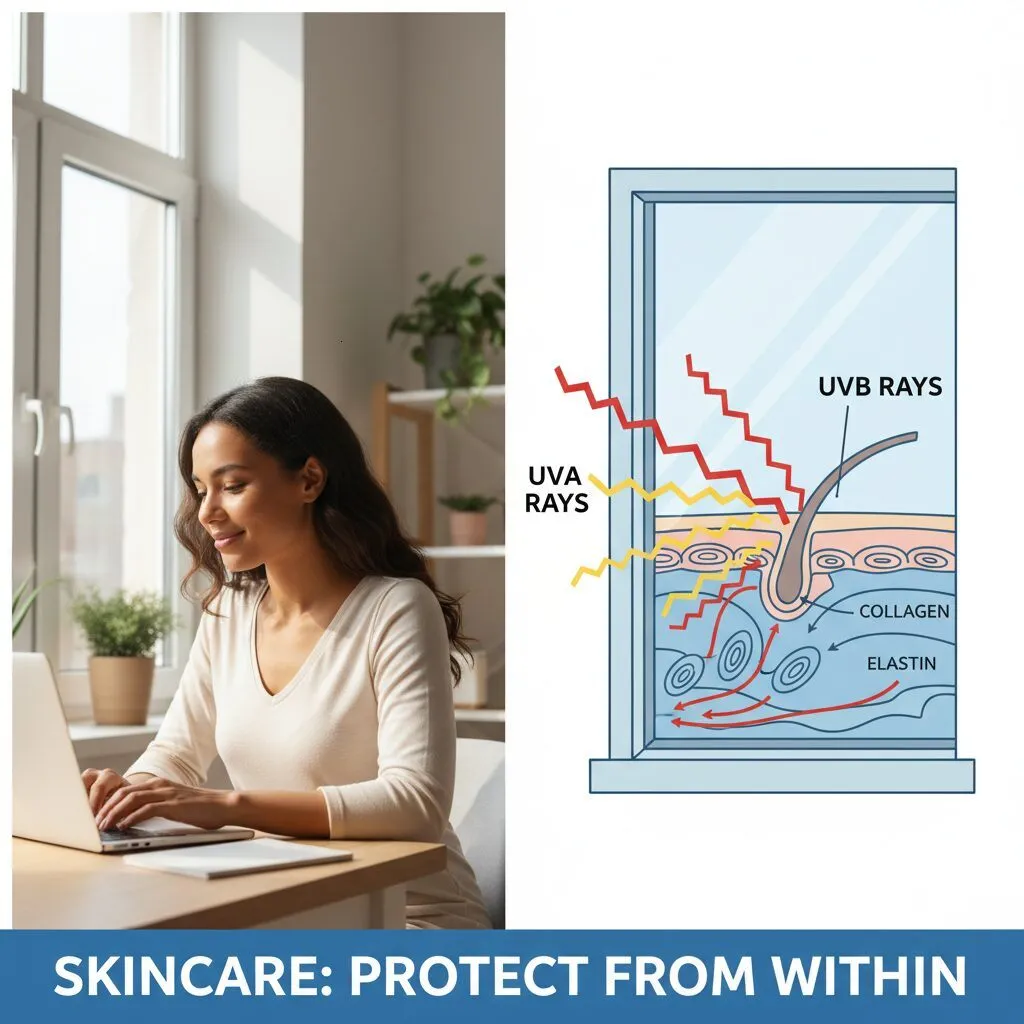
There is a dangerous misconception that being inside means being safe from the sun. The physics of glass tells a different story. The sun emits two primary types of ultraviolet radiation that reach us: UVB (burning rays) and UVA (aging rays).
Glass is great at blocking UVB rays. That’s why you rarely get a bright red sunburn while driving with the windows up. However, UVA rays have a longer wavelength, and this allows them to penetrate materials that stop UVB.
Standard vs. Laminated Glass
If you are sitting near a standard residential window, you are essentially sitting outside in terms of aging radiation. According to a July 2025 report by North American Tint, standard single-pane glass allows up to 75% of UVA radiation to pass right through.
One clinical study highlighted by Supergoop (May 2025) found that wrinkles and skin dehydration were significantly more pronounced on the side of the face with more window exposure, a phenomenon famously documented in long-haul truck drivers.
This is what dermatologists call “cumulative damage.” It’s not the one day at the beach that ages you; it’s the thousands of hours spent working next to a window over ten years. UVA rays penetrate deep into the dermis, where they destroy collagen and elastin fibers.
Interestingly, not all glass is created equal. A February 2025 study cited by Mirage News notes that while laminated glass (like your car’s front windshield) blocks 98-99% of UVA, the side windows and your home windows often block as little as 45%.
— Dr. Joyce Park, Dermatologist (via Allure/Miami Herald, 2024)
The Blue Light Threat: Is Your Screen Aging You?
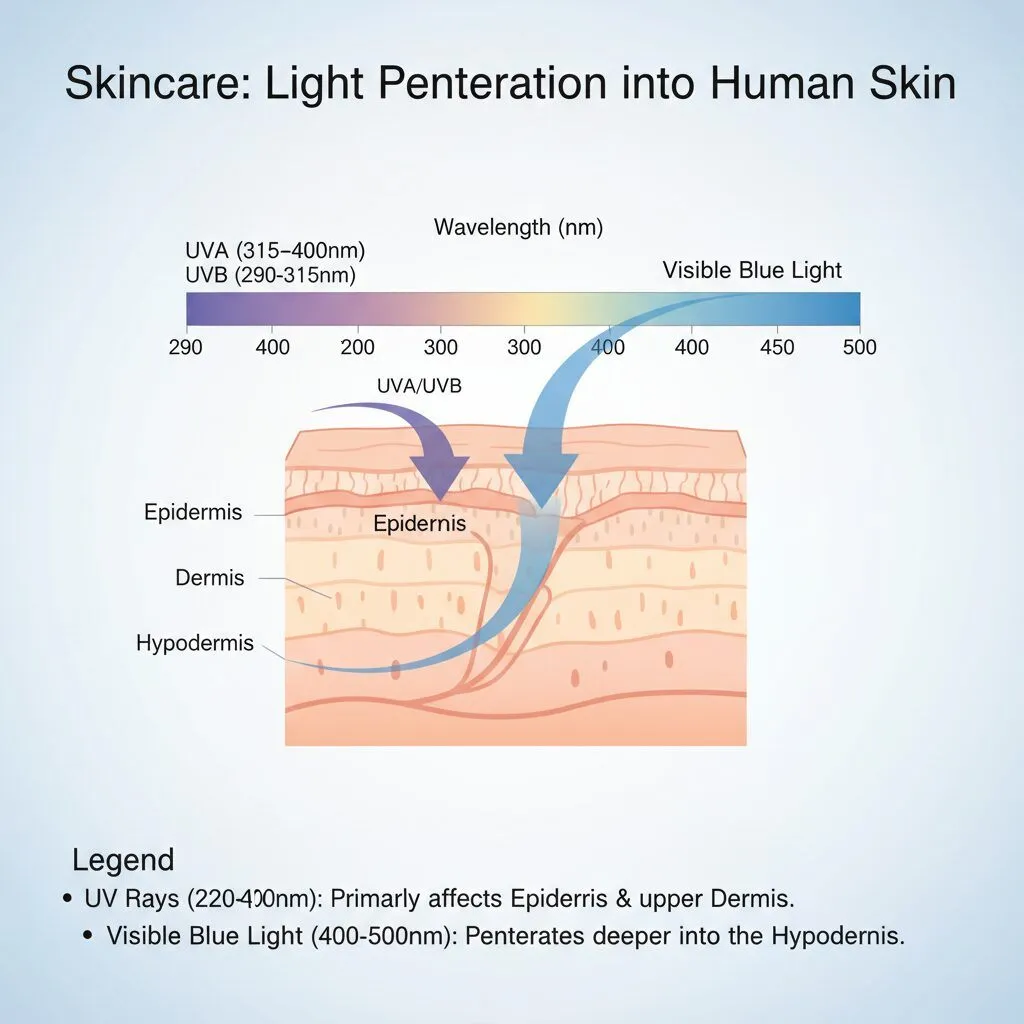
If the window wasn’t enough, we now have to contend with “Digital Aging.” This is where the conversation shifts from UV rays to High-Energy Visible (HEV) light, commonly known as blue light.
In my experience talking to skincare skeptics, this is usually where they roll their eyes. But the science is catching up to the skepticism. According to November 2025 data from Ramaeri/Professional Beauty, the average person now spends over 11 hours per day in front of a screen. That is a massive dose of radiation that didn’t exist for previous generations.
Deep Penetration and Pigmentation
Blue light doesn’t burn you, but it oxidizes you. Research published in the Journal of Cosmetic Dermatology (2024) suggests that blue light induces darker and more persistent hyperpigmentation than UVA rays, particularly in darker skin tones (Fitzpatrick types III-VI).
This light generates reactive oxygen species (free radicals) that attack your skin cells. A study from the Journal of Drugs in Dermatology (June 2024) confirmed that blue light exposure can cause a decrease in dermal density and collagen. Essentially, your Zoom calls are slowly breaking down the scaffolding of your skin.
You might think your screen isn’t bright enough to matter. However, a study cited by the NIH (July 2023) found that a dose as low as 20 J/cm² of blue light—roughly equivalent to a mix of sunlight and heavy screen use—can induce pigmentation.
Health vs. Aesthetics: More Than Just Wrinkles
While nobody wants premature wrinkles, the argument for indoor SPF goes beyond vanity. It’s a matter of public health.
The American Cancer Society estimates that 100,640 new melanomas will be diagnosed in the US in 2024 alone. Skin cancer doesn’t discriminate based on whether you were hiking or sitting in a sun-drenched reading nook.
Dr. Sunil Kalia of the University of British Columbia puts it bluntly: “Getting excessive sun rays causes DNA mutations… sunrays themselves are what cause generation of free radicals” (CBC News, July 2024). These free radicals don’t care if they originated from sunlight filtering through clouds or a window; the biological damage to the cell is identical.
Furthermore, cloud cover is deceptive. If you work near a window on a rainy day, you aren’t safe. According to the British Skin Foundation (March 2024), up to 80% of UV rays penetrate through clouds and mist.
How to Choose the Best Indoor Sunscreen
Okay, so we’ve established that the “skin door” needs to be closed. But wearing a thick, greasy, coconut-scented beach sunscreen at your desk is miserable. I’ve been there—it stings your eyes and ruins your clothes. The key to consistency is texture and formulation.
The Power of Iron Oxides (The 2025 Standard)
If you take one thing away from this article, let it be this: To block blue light, you need Iron Oxides.
Standard chemical sunscreens (Avobenzone, Octisalate) block UV rays, but they are virtually useless against visible blue light. Iron oxides are the pigments found in tinted sunscreens and foundations. They physically block HEV light from penetrating the skin.
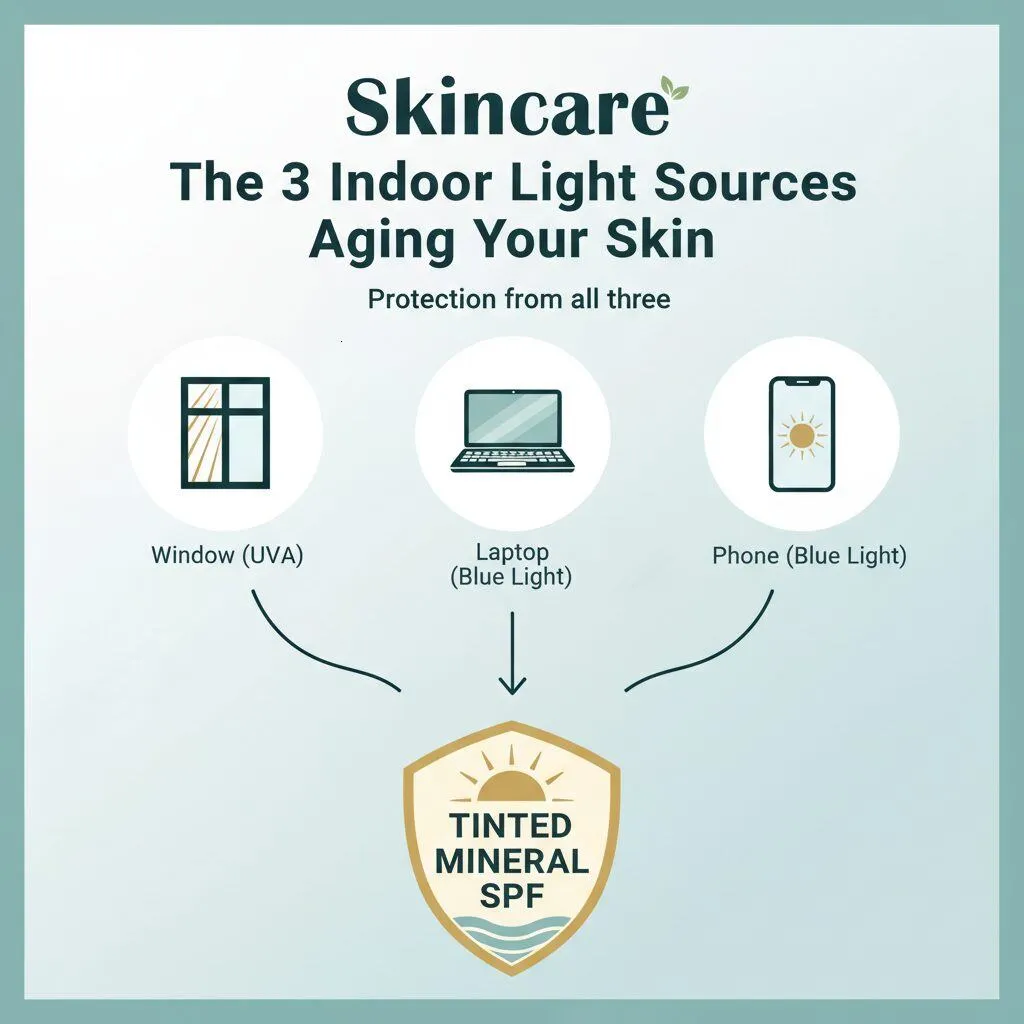
This is why dermatologists are shifting their recommendation in 2025 toward tinted mineral sunscreens for indoor workers. It acts as a shield against both the window (UVA) and the screen (Blue Light).
| Feature | Chemical SPF | Mineral SPF (Untinted) | Tinted Mineral SPF |
|---|---|---|---|
| UVA Protection | Good (varies by filter) | Excellent | Excellent |
| Blue Light Protection | None | Low | High (Iron Oxides) |
| White Cast | None | Likely | None (Blends in) |
| Best For | Quick absorption | Sensitive skin | Indoor/Office Days |
Practical Indoor SPF Routine for 2025
Building a habit is hard. According to Talker Research (Aug 2024), only 35% of Gen Z wear facial sunscreen daily. To make this stick, you need a “set it and forget it” approach.
The Morning Ritual
Treat your SPF as the final step of your skincare, not the first step of makeup. Apply a nickel-sized amount of tinted SPF to your face and neck. If you are using a vitamin C serum underneath, you get bonus points—antioxidants help neutralize the free radicals that slip past the sunscreen.
The Reapplication Rule
Do you need to reapply every two hours indoors? Honestly, probably not. Unlike at the beach, you aren’t sweating or swimming it off.
However, if you sit in direct sunlight, or if you touch your face often, the film degrades. My personal hack is to keep a powder SPF brush at my desk. It mattifies my face for Zoom calls and adds a quick layer of mineral protection without messing up my moisturizer.
— Dr. Robyn Gmyrek, Dermatologist (British Journal of Dermatology, Jan 2024)
Frequently Asked Questions
If you are in a room with natural light, you are exposed to UVA rays, which bounce off walls and surfaces. Dr. Harold Lancer states, “If you can see where you are walking without a flashlight, there is enough light to require sunscreen” (CNN/Miami Herald, 2024).
Yes. While less potent than the sun, the duration of exposure matters. Data from Professional Beauty (2024) notes that blue light generates oxidative stress, leading to collagen breakdown over time, a process known as “digital aging.”
Most standard household LED bulbs do not emit significant UV radiation. However, they do emit HEV (blue) light. If you have older halogen or fluorescent bulbs, those can emit low levels of UV.
Yes, SPF 30 is generally sufficient for indoor use, provided it is “Broad Spectrum” (blocking UVA and UVB). However, ensure it contains iron oxides if you want protection from screen light.
Usually, no. To get the SPF protection stated on the bottle, you need to apply a thick layer. Most people apply makeup too thinly. Use a dedicated sunscreen first, then makeup.
Conclusion: Closing the Skin Door
It’s easy to dismiss indoor sunscreen as “extra” or unnecessary. But when we look at the data—75% UVA penetration through windows, 11+ hours of daily screen time, and the rising rates of melanoma—it becomes clear that our definition of “sun exposure” needs an update.
Wearing SPF indoors isn’t about paranoia; it’s about preservation. It’s the single most effective anti-aging product you can buy, far outperforming expensive creams and serums.
Your Action Plan:
- Identify your light sources (windows and screens).
- Switch to a tinted mineral sunscreen (SPF 30+) to block both UVA and Blue Light.
- Apply it every morning as a non-negotiable habit, just like brushing your teeth.
Your future self—and your collagen—will thank you.