


How Often Should You Reapply Sunscreen? The 2025 Dermatologist Guide
You apply your favorite SPF 50 at 8:00 AM, feeling responsible and protected. You drive to work, sit at your desk, and maybe step out for a quick coffee. By 10:00 AM, you might assume you’re still covered.
Here’s the harsh reality: even if you haven’t stepped foot on a beach, your protection may have degraded by nearly 20% in just those two hours. If you’re like me, you’ve probably learned this the hard way—nursing a red nose after a day that felt “mostly indoor.”
The question of how often should you reapply sunscreen isn’t just about avoiding a temporary burn; it’s about navigating a serious health landscape. According to the Skin Cancer Foundation’s January 2025 report, an estimated 212,200 cases of melanoma will be diagnosed in the U.S. this year alone—a 5.9% increase from previous years.
In my years researching dermatological care, I’ve found that while most people know to wear sunscreen, almost no one gets the timing right. The “2-hour rule” is the gold standard, but new research from 2025 suggests that specific environments—like your car or your office—require a different strategy.
This article cuts through the noise. We will move beyond the generic advice and look at the chemistry of broad-spectrum protection, explaining exactly when to reapply whether you are swimming, sweating, or wearing a full face of makeup.

The Core Rule: Why Every 2 Hours?
You’ve likely heard the “every two hours” mantra until it’s lost its meaning. But understanding the why changes everything. It’s not just that the lotion rubs off on your clothes or evaporates. The primary culprit is a chemical reaction known as photostability breakdown.
Understanding UV Breakdown
Sunscreen filters, particularly chemical ones like avobenzone, work by absorbing ultraviolet radiation and converting it into heat. This is a sacrificial process. As they absorb UV rays, the chemical bonds break down. Once those bonds are broken, the filter can no longer absorb energy. It’s like a gas tank—once the fuel is used up, the car stops running.
According to data archived by the NIH from the Journal of the Medical Association of Thailand (2024 reference), face sunscreen coverage in indoor workers reduces by roughly 16.3% after just 2 hours. After 8 hours? That protection drops by 28.2%. That’s nearly a third of your protection gone, just by sitting there.
Physical vs. Chemical: Does the Type Change the Timing?
I often get asked if mineral sunscreens (zinc oxide or titanium dioxide) last longer because they reflect light rather than absorb it. While mineral filters are generally more photostable, they are physically unstable. They sit on top of the skin and are easily disrupted by:
- Touching your face (we do this hundreds of times a day)
- Natural facial oils (sebum production)
- friction from clothing or phone screens
So, whether you choose chemical or mineral, the 2-hour rule remains the baseline for safety.
— Dr. Susan Y. Chon, MD Anderson (Sept 2024)
The “Double Application” Strategy: A Research-Backed Shortcut
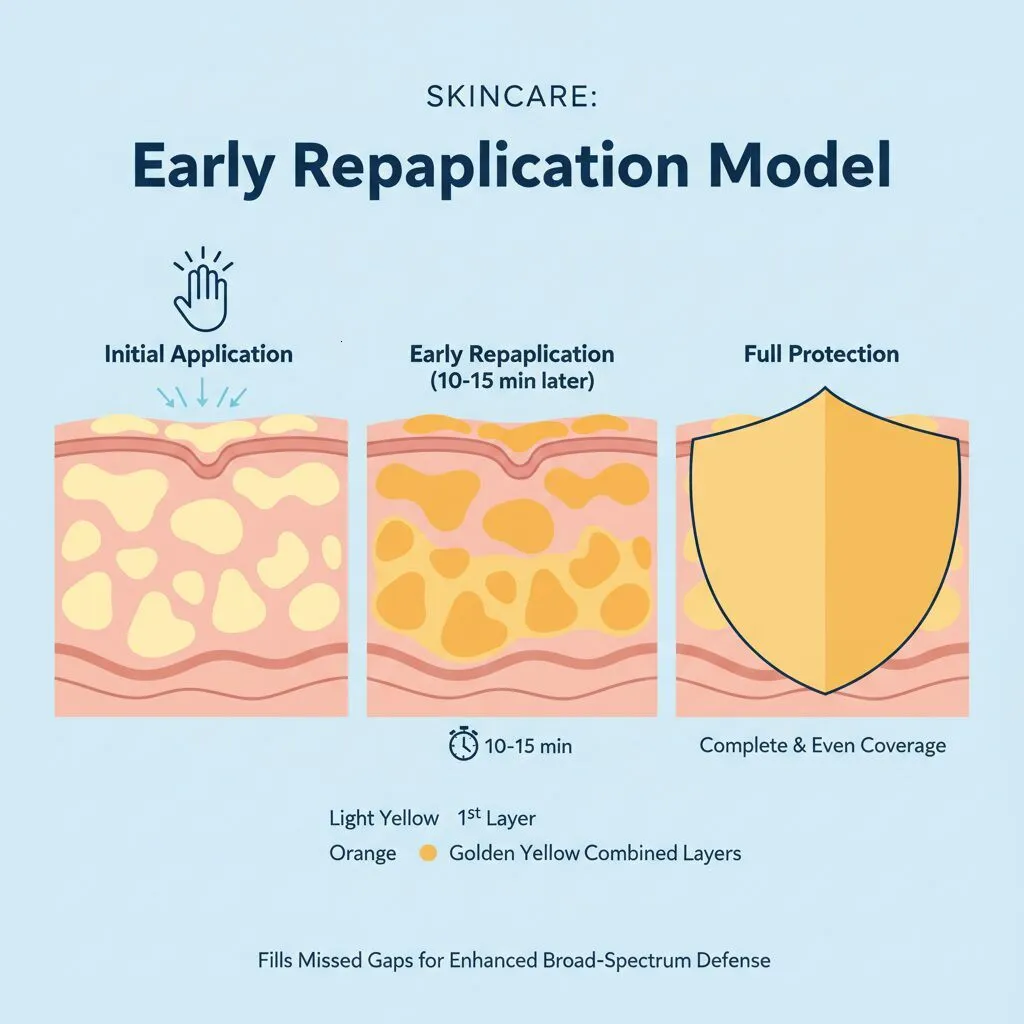
Here is a piece of advice you won’t find on the back of the bottle, but it’s supported by the latest mathematical modeling. It’s called the “Early Reapplication” technique.
A ResearchGate/NIH study published in August 2025 utilized mathematical modeling to analyze UV exposure. The results were fascinating: they suggest that reapplying sunscreen just 20 minutes after your initial exposure—rather than waiting the full two hours—can result in 60-85% less cumulative UV exposure over the course of the day.
Why? Because most of us apply sunscreen unevenly. We miss spots. We apply too thin a layer. That second layer, applied early, acts as a “sealant,” filling in the microscopic gaps you missed the first time. If you are planning a full beach day, try this: Apply at home, arrive at the beach, and reapply immediately. You are then set for the next two hours with significantly better coverage.
Specialized Scenarios: When the 2-Hour Rule Changes
Life doesn’t always happen in clear, two-hour blocks. Different activities degrade your sun protection factor (SPF) at different rates.
High-Intensity Activity: Swimming and Sweating
If you are jumping in the pool or running a marathon, the 2-hour rule is dangerous. Water creates friction and acts as a solvent, physically stripping the sunscreen from your skin.
Regulatory bodies classify “water-resistant” sunscreen into two categories:
- Standard Water Resistance: Effective for 40 minutes.
- Very Water Resistant: Effective for 80 minutes.
Note that no sunscreen is “waterproof.” That term was actually banned by the FDA years ago because it was misleading.
— Dr. Amanda Valdes, Cleveland Clinic (March 2025)
I’ve seen friends burn severely because they swam for an hour, got out to dry off, and thought they had another hour on the clock. If you towel dry, you must reapply immediately. The mechanical action of the towel wipes away whatever protection survived the water.
The “Indoor” Myth: Do You Need a Top-Up at Your Desk?
This is where the debate often heats up. Do you really need to reapply if you work in an office? In my opinion, the answer depends entirely on your proximity to windows.
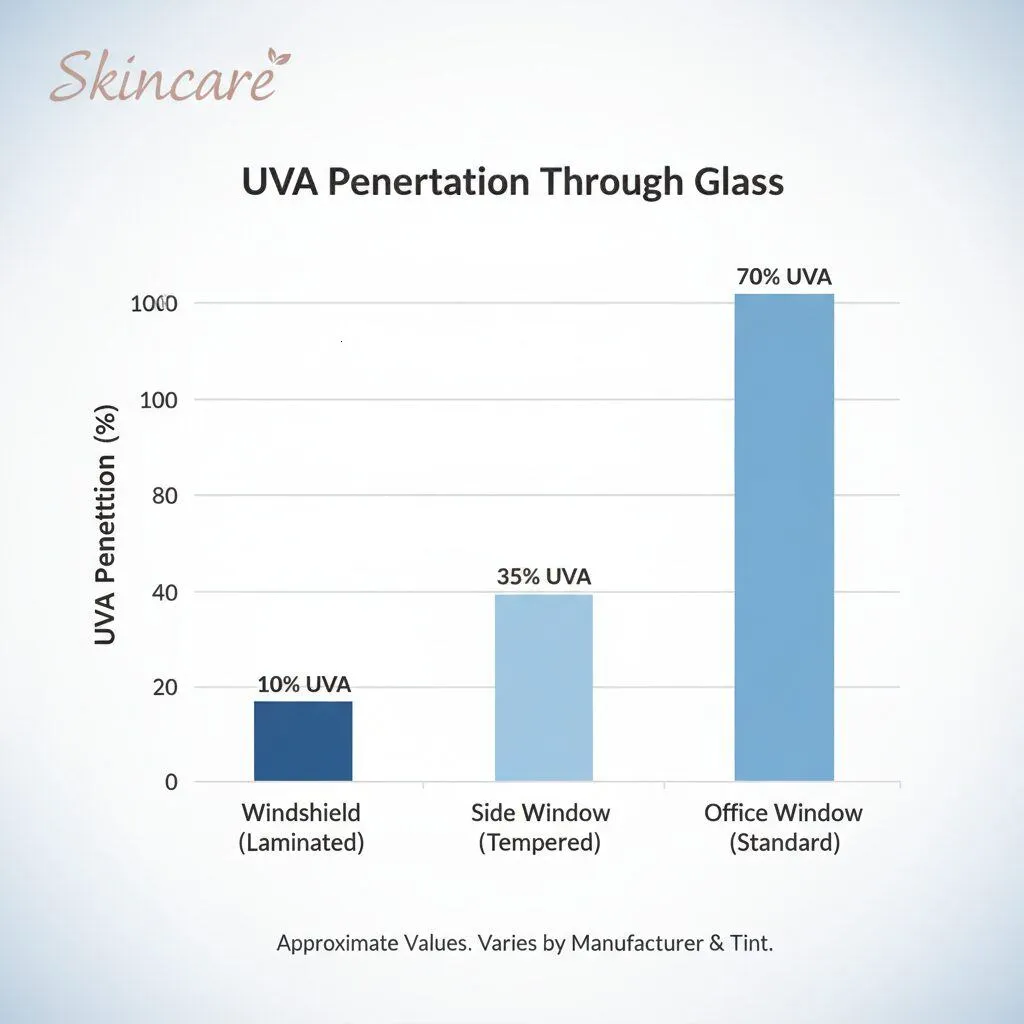
Standard glass blocks UVB rays (the ones that cause burning), but it lets UVA rays (the ones that cause aging and deep cellular damage) pass right through. If you sit next to a window, you are essentially sitting in a UVA tanning booth all day.
Furthermore, new data on visible light (blue light) suggests it can contribute to hyperpigmentation, especially in darker skin tones. Iron oxide-containing sunscreens (usually tinted ones) are best for this.
Driving and Travel: Why Side Windows Are Your Skin’s Enemy
I was shocked to learn the discrepancy between windshields and side windows. While windshields are made of laminated glass that blocks most UVA, side windows are typically tempered glass.
If you are on a road trip, the arm and side of the face next to the window are getting blasted. For long drives, I recommend reapplying every 2 hours, or better yet, wearing UV-protective clothing (UPF sleeves) so you don’t have to worry about the cream.
How to Reapply Without Sabotaging Your Routine
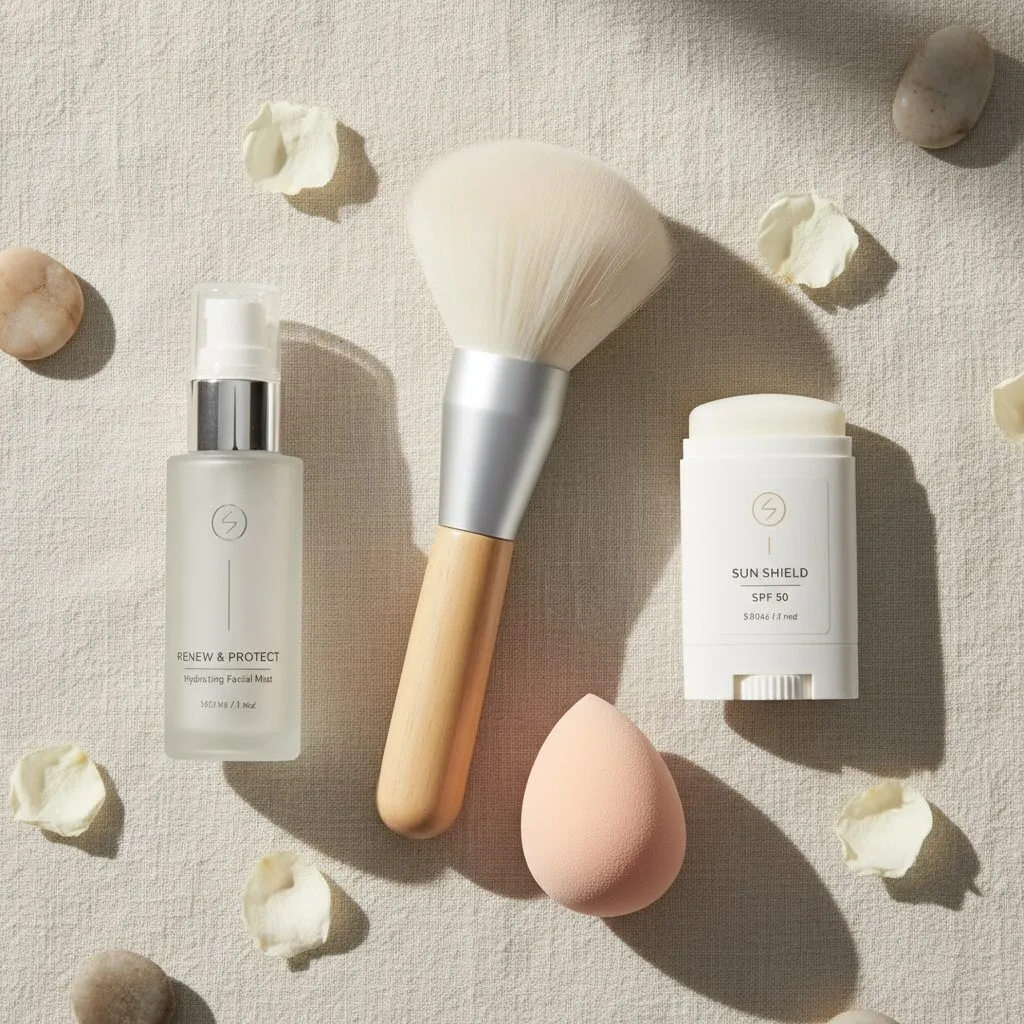
The biggest barrier to reapplication isn’t laziness; it’s logistics. How do you reapply sunscreen over a full face of foundation without looking like a greasy mess? This is the number one complaint I hear.
Fortunately, the market has exploded with solutions in 2024 and 2025. With the global sunscreen market projected to reach $8.7 billion by 2031 (According to Cognitive Market Research, Oct 2024), innovation is rapid.
Techniques for Reapplying Over Makeup
| Method | Best For | Pros | Cons |
|---|---|---|---|
| SPF Powder | Oily Skin / Matte Finish | Sets makeup, absorbs oil, non-messy. | Hard to get high coverage; best as a top-up only. |
| SPF Face Mist | Dry Skin / Dewy Finish | Fast, refreshing, no touching required. | Must spray generously to get stated SPF protection. |
| Makeup Sponge (Dab Method) | Full Coverage Makeup | Maintains coverage integrity. | Takes longer; requires a clean sponge. |
| Sunscreen Stick | Targeted Areas (Eyes/Nose) | Portable, no spill, precise. | Can drag foundation if applied too firmly. |
My Personal Routine: I keep an SPF powder in my bag for work days. It takes away the mid-day shine and adds a layer of mineral protection. For beach days, however, I stick to lotions and sprays—powders just aren’t robust enough for direct noon sun.
Handling Facial Hair and Sensitive Areas
Men often neglect the beard area, assuming hair protects the skin. While it offers some shade, UV rays penetrate easily. A spray or a lightweight fluid sunscreen works best here to avoid the white residue that sticks to stubble. Don’t forget the ears, the back of the neck, and the part in your hair (or a bald spot)—these are common sites for precancerous lesions.
The Reality of Skin Cancer Risks
It is easy to dismiss these rules as overly cautious, but the statistics paint a worrying picture. A May 2024 survey from the American Academy of Dermatology (AAD) found that 50% of Gen Z adults reported being sunburned in 2024, despite 96% of them believing sun protection is important.
There is a disconnect between belief and action. We know we need it, but we aren’t doing it often enough.
— Dr. Veena Vanchinathan, AAD (May 2025)
Furthermore, a study presented at the ASN Events/Skin Cancer 2024 conference showed that “detailed icons” on packaging increased reapplication knowledge by 2.6x compared to text-only labels. This suggests that once we visualize the risk and the schedule, we get better at compliance.
FAQ: Common Reapplication Questions
Does higher SPF mean I reapply less often?
No. This is a dangerous myth. SPF (Sun Protection Factor) indicates how well the product blocks UVB rays, not how long it lasts. SPF 100 breaks down just as fast as SPF 30. You must reapply both every 2 hours.
Do I need to reapply sunscreen on a cloudy day?
Absolutely. Up to 80% of UV rays penetrate through clouds. The burn might feel less intense because the infrared heat is blocked, but the DNA-damaging UV radiation is still hitting your skin.
Can you reapply sunscreen over sweat?
Ideally, you should towel off the sweat first. Applying lotion over a layer of sweat prevents the film from forming on your skin. Dry the area, apply the sunscreen, and wait a few minutes for it to bind before sweating again.
How to reapply sunscreen while swimming in a pool?
Get out of the water, dry your skin completely with a towel, apply the sunscreen generously, and—this is the hard part—wait at least 15 minutes before getting back in. If you jump right back in, the water will wash the product off before it sets.
How often to reapply sunscreen indoors near windows?
If you are within 3-5 feet of a window with direct sunlight, stick to the 2-hour rule or check if your windows have UV film. If you are in a windowless room, a single morning application is generally sufficient, though a touch-up before leaving work is recommended to protect you on the commute home.
Conclusion: Your Daily Protection Checklist
Reapplying sunscreen isn’t about striving for perfection; it’s about reducing cumulative damage. We can’t live our lives in a dark room, and we shouldn’t have to. By understanding the mechanisms of photostability and water resistance, you can enjoy the sun safely.
To summarize the 2025 guidelines:
- Standard Day: Reapply every 2 hours if you are outdoors or near a window.
- Water/Sweat: Reapply every 40 to 80 minutes, immediately after toweling off.
- The Pro Tip: Use the “Early Reapplication” method (20 minutes after the first coat) for high-exposure days.
- The Commute: Don’t trust your side windows—reapply before long drives.
Your skin is your body’s largest organ, and it remembers every burn. Taking that extra minute every two hours to reapply is the single best investment you can make for your future health.