 Johnson
Can You Apply Moisturizer on Wet Skin? The Science-Backed “3-Minute Rule” for 2025
Imagine this: You step out of a steamy shower, grab a towel, and dry off completely before reaching for your expensive body lotion. It feels like the logical routine, right? But here is the uncomfortable truth: by the time your skin is bone dry, the damage is already underway.
In my years analyzing skincare efficacy, the single biggest mistake I see isn’t the product people choose—it’s the timing. Within 60 seconds of leaving the shower, your skin begins losing moisture at an accelerated rate through a process called Transepidermal Water Loss (TEWL). If you wait too long, you aren’t just missing an opportunity; you’re actively fighting against physics.
The “Damp-Skin Method” isn’t just a TikTok trend; it’s rooted in molecular science. According to a June 2024 study published by the NIH/PMC, applying a Hyaluronic Acid serum on damp skin can increase immediate skin hydration by a staggering 134%. That is the difference between skin that feels tight by noon and skin that remains resilient all day.
Increase in hydration when Hyaluronic Acid is applied to damp skin.
(Source: NIH/PMC, June 2024)
In this guide, we will dismantle the confusion between “wet” and “damp” skin, explore the definitive “3-Minute Rule,” and reveal why applying retinoids to wet skin is a recipe for disaster.
The Science of the “Damp-Skin Method”
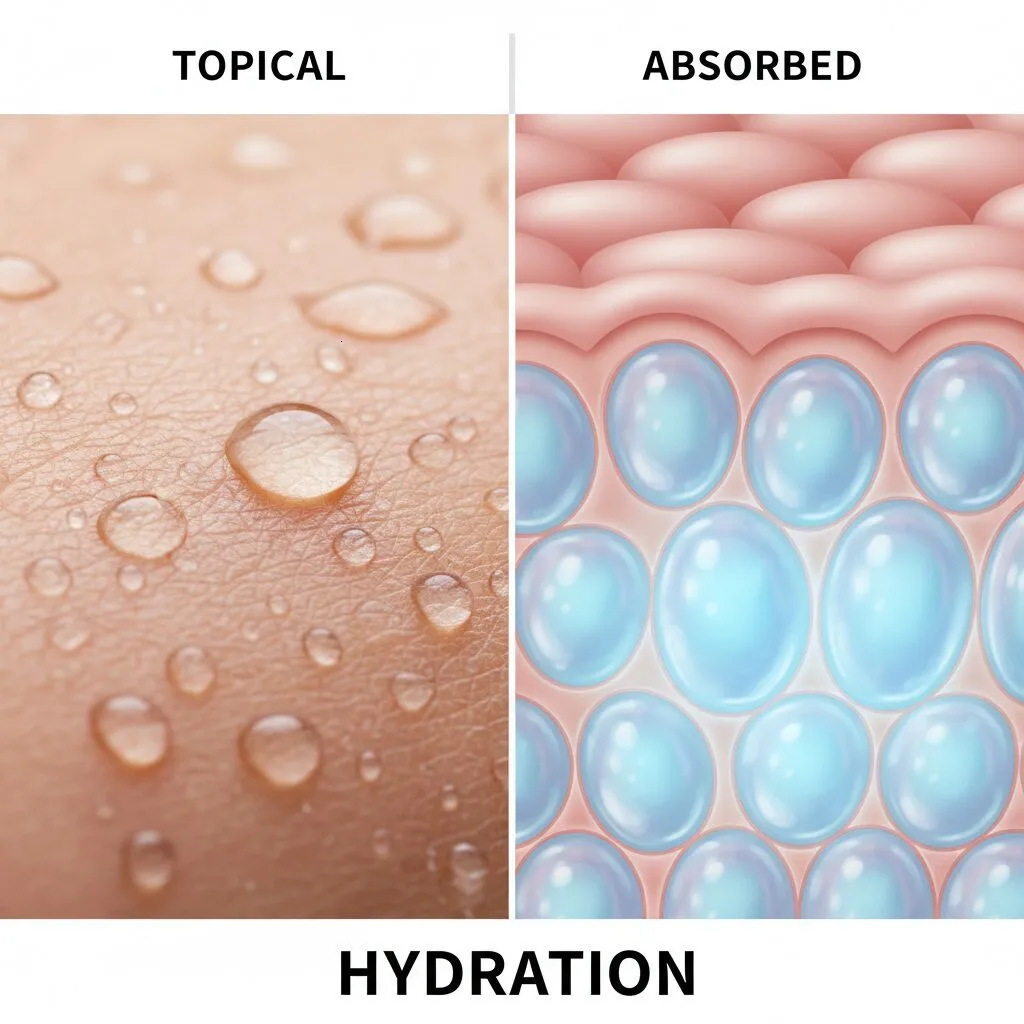
To understand why timing is everything, we have to talk about what happens to your skin the moment the water stops running. Your skin acts somewhat like a sponge. When a sponge is bone dry and hard, you can pour water on it, but it takes time to absorb; much of the water just runs off the surface. However, a damp sponge absorbs new liquid instantly.
What is Transepidermal Water Loss (TEWL)?
TEWL is the passive evaporation of water from the deep layers of your skin (dermis) out through the top layer (epidermis) into the atmosphere. It’s happening constantly, but a hot shower accelerates it.
When you shower, the heat and water strip away some of the natural oils (sebum) that act as a sealant. Once you step out, the water on your skin starts to evaporate, and thanks to the laws of osmosis, it drags your skin’s internal moisture out with it. Data from the Siriraj Medical Journal (Oct 2025) reveals a startling statistic: 56.9% of total post-immersion water loss occurs within the first 10 minutes. If you aren’t sealing your skin within that window, you are essentially letting your hydration evaporate into thin air.
How Dampness Changes Permeability
When your skin is damp, your corneocytes (skin cells) swell. This swelling creates temporary channels and creates a “concentration gradient” that allows hydrophilic (water-loving) ingredients to penetrate deeper. By applying moisturizer now, you are trapping the water that is already sitting on the surface and pushing it into the skin, rather than relying solely on the moisture in the bottle.
— Dr. Hadley King, NYC Dermatologist (Nov 2024)
Damp vs. Wet vs. Dry Skin: The Technical Difference
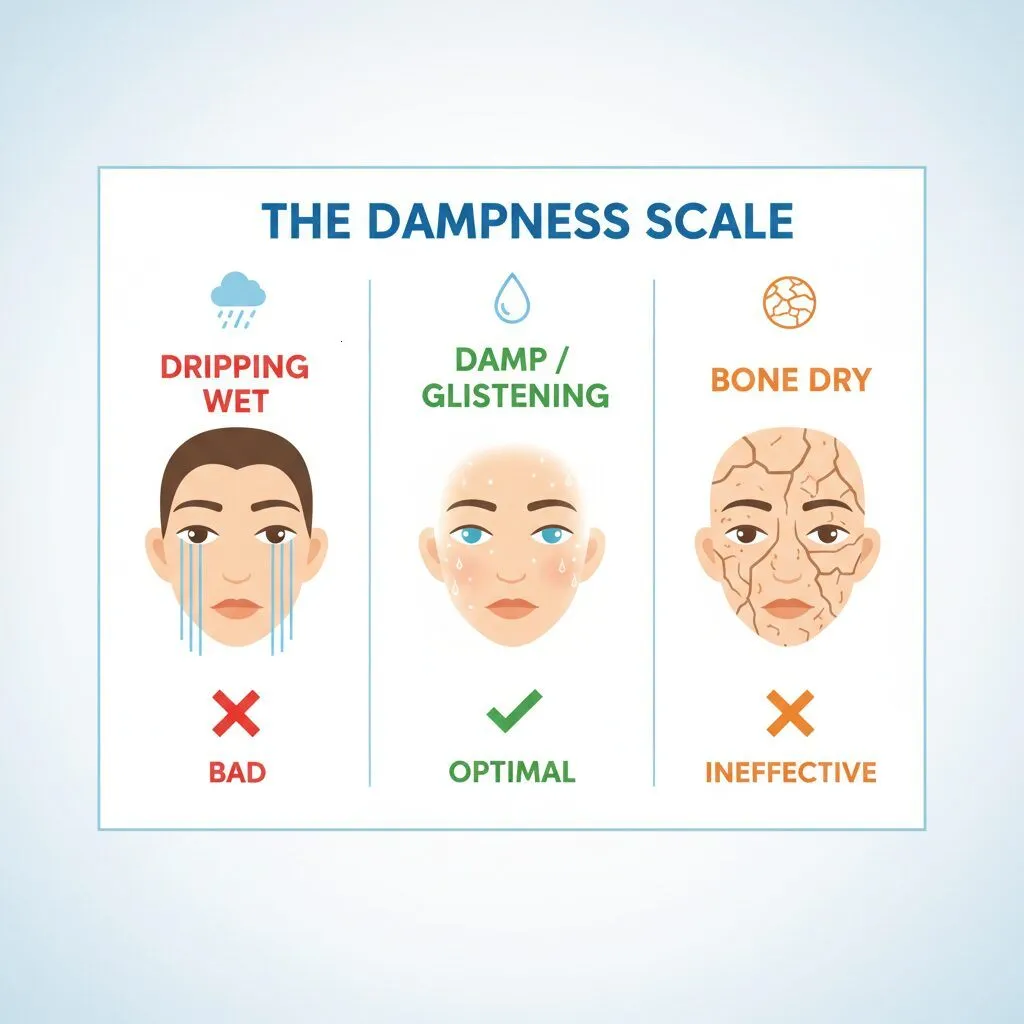
This is where most people get it wrong. “Wet” does not mean dripping. If you apply lotion to soaking wet skin, you run the risk of sliding, product soaping, and dilution. We need to find the “Goldilocks zone.”
1. Soaking Wet (Dripping)
If water is running down your face or body, your skin is too wet. Applying a cream now will cause it to emulsify with the water on your skin, often turning white and soapy. More critically, you are diluting the concentration of the product. If your moisturizer is 15% glycerin, mixing it with surface water might drop that effective percentage down significantly, reducing its efficacy.
2. Damp Skin (The Target)
This is the “glistening” state. You have patted with a towel, but the skin feels cool and slightly tacky to the touch. It is not dripping, but it is not matte. According to Dr. Angela J. Lamb (Mount Sinai), this state allows moisturizers to “trap moisture from the water on your skin,” effectively doubling the hydration source.
3. Bone Dry
This occurs when you wait too long—usually past the 3-to-5-minute mark. The surface water has evaporated, and the corneocytes have begun to shrink back down. Applying moisturizer now is still better than nothing, but you have lost the “free” hydration from the shower.
The 3-Minute Rule: A Step-by-Step Routine
In 2025, the “3-Minute Rule” is the standard for barrier repair. While studies suggest you might have up to 10 minutes before TEWL stabilizes, the peak loss happens fast. According to ResearchGate (Oct 2025), TEWL values statistically increase after only 5 minutes of air-drying. I recommend aiming for a 3-minute window.
Step 1: Gentle Cleansing
It starts in the shower. Use a cleanser that respects the lipid matrix. If your skin squeaks, it’s too clean. You want to retain some natural oils.
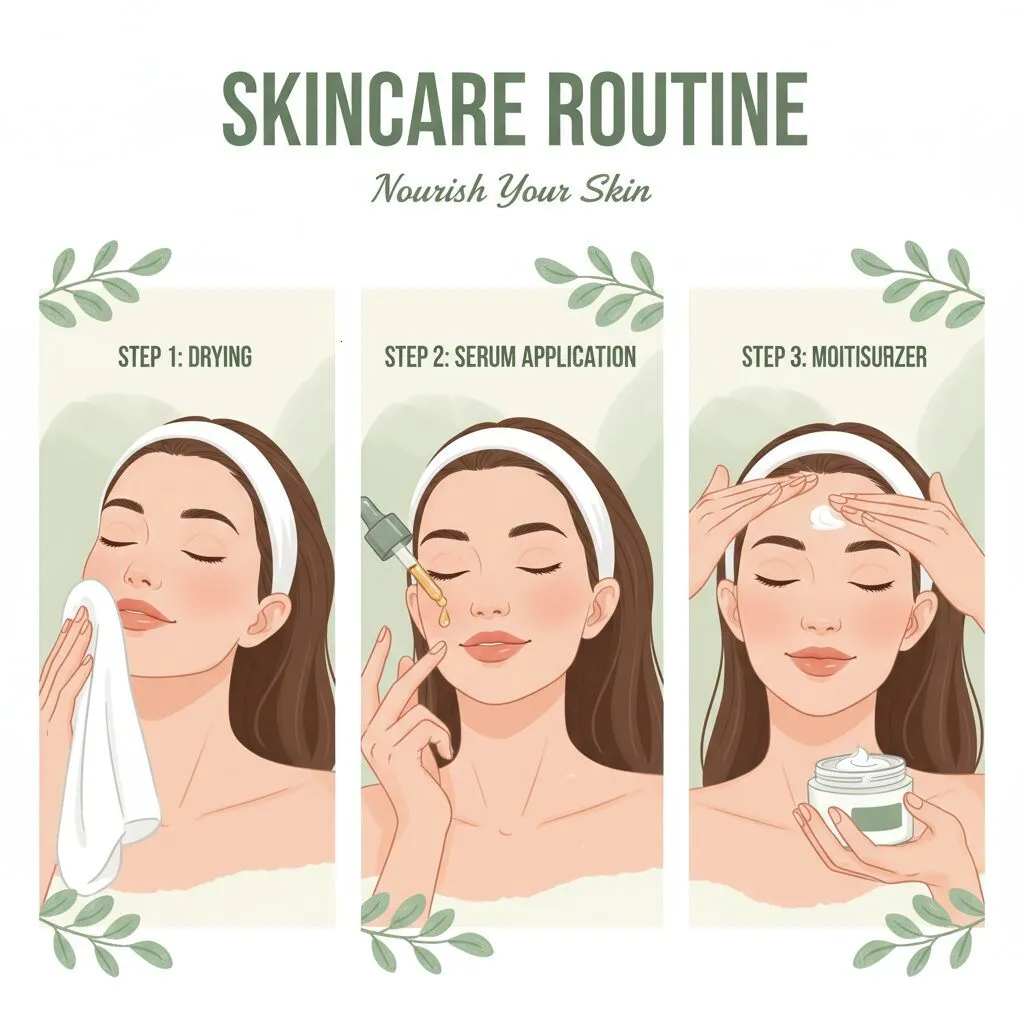
Step 2: The “Pat-Dry” Technique
Do not rub your towel vigorously. Instead, gently press the towel against your skin to absorb the dripping water. Remove 80% of the water, leaving 20% behind.
Step 3: Layering (Serum → Moisturizer → Oil)
According to Dr. Marisa Garshick (Cornell, Aug 2024), “It’s essential to apply hyaluronic acid products on damp skin and follow up with a moisturizer to seal in the hydration.”
- First: Apply humectants (Serums) to grab the surface water.
- Second: Apply your emollient cream to smooth the skin.
- Third: (Optional) Apply an occlusive oil to lock the gate.
Best Ingredients for Wet Skin Application
Not all ingredients behave the same way on wet skin. Some love water (hydrophilic), and some hate it (hydrophobic). To master the wet skin method, you need to know which is which.
Humectants: The Water Magnets
Ingredients like Hyaluronic Acid, Glycerin, and Polyglutamic Acid are humectants. They work by bonding with water molecules. If you apply these to dry skin in a dry climate, they can actually pull water out of your skin. But on wet skin? They are supercharged.
A Kenvue AAD Meeting report (March 2025) highlighted that Oat flour, often used in eczema creams, boosts natural HA production by 43% when used in barrier regimens, making it a powerhouse for damp application.
Occlusives: The Sealants
These ingredients don’t mix with water; they sit on top of it. This creates a physical barrier that prevents evaporation. The undisputed king here is petrolatum. According to Clinikally (July 2025), pharmaceutical-grade petrolatum reduces TEWL by 98-99%.
Dr. Joshua Zeichner of Mount Sinai states, “Petrolatum is the most effective moisturizer we have… it remains the gold standard for treating dry skin and eczema.” For the best results, apply these heavier creams immediately after your water-based serums.
When NOT to Apply on Wet Skin
This section is critical. While hydration loves damp skin, irritation loves it too. Because wet skin is more permeable, active ingredients penetrate deeper and faster. For soothing ingredients, this is great. For potent actives, it can be dangerous.
Do not apply Retinoids (Retinol, Tretinoin), Vitamin C (L-Ascorbic Acid), or Alpha Hydroxy Acids (Glycolic Acid) on wet skin unless specifically directed by a dermatologist.
The Risk of “The Uglies”
Applying retinol to damp skin can significantly increase the incidence of “retinization” or “the retinoic uglies”—redness, peeling, and burning. The water acts as a vehicle, dragging the acid deeper than intended.
If your routine includes these actives, use the sandwich method: Apply a light moisturizer on damp skin, wait 10-15 minutes for it to dry, apply your active, and then moisturize again.
Skincare Statistics: Why Timing Matters in 2025
The shift towards barrier repair is backed by hard numbers. The global skin repair market is expected to reach $84.96 billion in 2024, according to BioSpace (Oct 2024). This isn’t just marketing; it’s a consumer response to damaged skin.
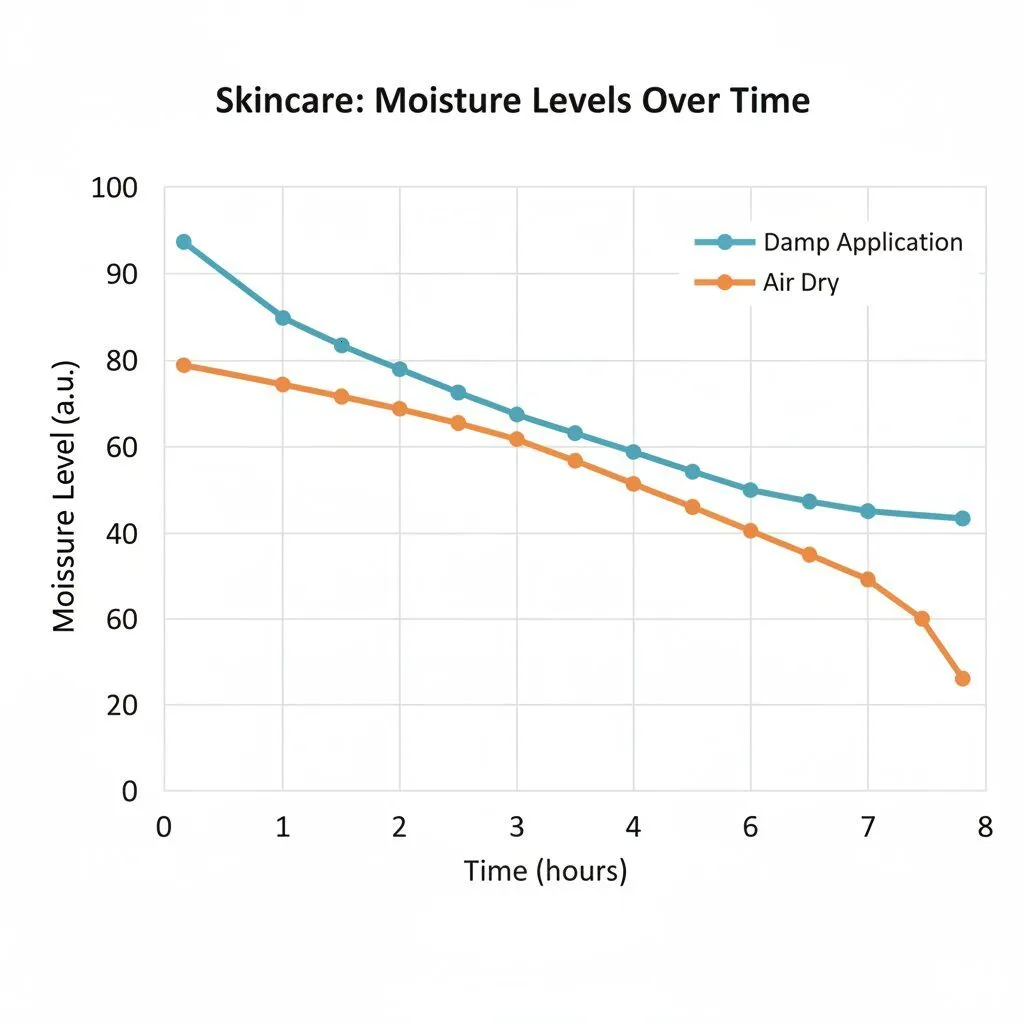
Furthermore, a clinical model known as the “Soak and Smear” technique—soaking skin for 20 minutes followed by immediate petrolatum application—resulted in a 98% reduction in TEWL and rapid healing of the stratum corneum, as reported by MDEdge (2024). Even for infants, regular use of occlusives on high-risk skin reduces the incidence of eczema by 50% (Journal of Allergy and Clinical Immunology, 2024).
Expert FAQ: Solving Your Hydration Puzzles
1. Can I put face lotion on soaking wet skin?
Technically yes, but it isn’t optimal. As mentioned earlier, dripping water can dilute the formulation and make it difficult for the product to absorb (it will just slide around). Pat off the excess drips first so the skin is damp, not swimming.
2. Does moisturizer work better on dry or damp skin?
For hydration and barrier repair, it works significantly better on damp skin. A 2024 NIH study confirmed a massive 134% increase in hydration when humectants are applied to damp skin compared to dry skin. However, for prescription retinoids, dry skin is safer to prevent irritation.
3. Why does my moisturizer soap up on wet skin?
This is the “soaping effect.” It happens when the emulsifiers in your cream react with the excess water on your face. It usually means you are using too much product or your skin is too wet. Blot your face with a towel and pat the product in rather than rubbing.
4. Is the 3-minute rule real?
Yes. While you don’t need a stopwatch, the science of TEWL shows that moisture loss accelerates rapidly after you leave the humid environment of the shower. The Siriraj Medical Journal (2025) indicates that the “window of opportunity” begins closing after 3 to 5 minutes.
5. Should I apply body oil before or after lotion on wet skin?
The general rule is thinnest to thickest. However, oils are occlusives. If you apply oil first on wet skin, it traps the water effectively, but it might block your lotion from penetrating. I recommend mixing them or applying the lotion first (to hydrate) and the oil second (to seal).
Conclusion: The 60-Second Target
The verdict is clear: applying moisturizer on damp skin is not a myth—it is a biological hack for better skin health. By trapping the water from your cleanse, you are essentially giving your moisturizer a “hydro-boost” that no expensive ingredient can replicate on its own.
While the “3-Minute Rule” gives you a safety buffer, I challenge you to aim for the “60-Second Target.” Keep your body lotion and face serums inside the bathroom. The moment you pat dry, apply your first layer. Your skin barrier, currently fighting a losing battle against evaporation, will thank you.
- The Sweet Spot: Apply products to damp, glistening skin—not dripping wet.
- The Boost: Humectants like Hyaluronic Acid work 134% better on damp skin.
- The Exception: Always apply Retinoids and Vitamin C to dry skin to avoid irritation.
- The Timing: You have a maximum of 3 to 5 minutes before significant water loss occurs.